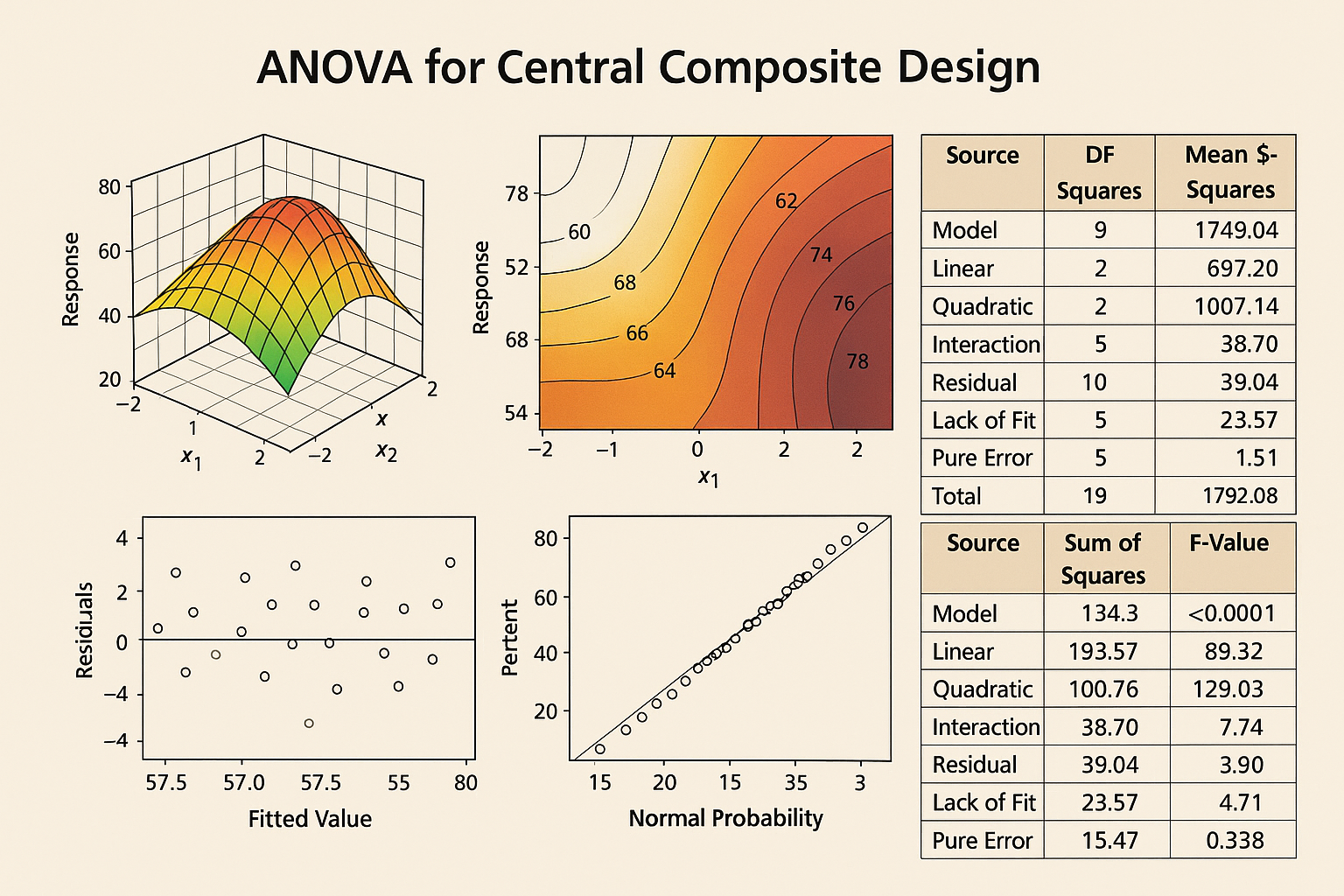
A Practical Guide for Engineers and Product Developers
When it comes to optimising engineering processes, Design of Experiments (DoE) plays a critical role.

One of the most powerful tools within this methodology is the Central Composite Design (CCD) — an approach that helps engineers model complex systems and identify optimal conditions with precision.
In this article, we’ll explain what CCDs are, how they’re used in engineering and product development, and share real-world examples that demonstrate their impact.
✅ What Is a Central Composite Design?
A Central Composite Design is a structured approach used in response surface methodology (RSM) to build predictive models and explore how input variables affect outcomes.
A CCD combines three types of experimental points:
- Factorial points – Traditional full or fractional factorial combinations
- Axial (star) points – Extremes that stretch the design space
- Centre points – Replicated runs at the midpoint of the variable ranges
Together, these allow for the fitting of second-order (quadratic) models, enabling non-linear optimisation and robust prediction.
🎯 Why Use CCDs?
- Ideal for optimising processes when curvature is suspected in the response
- Excellent for refining systems after initial screening experiments
- Requires fewer runs than full factorial designs with similar insight
- Helps identify interactions and quadratic effects
🔍 Real-World Applications of CCDs
📦 1. Optimising Material Strength in 3D Printing
A major additive manufacturing company used a CCD to explore how print speed, extrusion temperature, and layer thickness influenced tensile strength. The CCD model helped them reduce breakage rates by 18% while improving surface finish.
⚙️ 2. Refining Fuel Efficiency in Automotive Engines
An engine design team applied a CCD to optimise injection timing, pressure, and air-fuel ratio. The result? A 7% fuel efficiency gain with no compromise on emissions — achieved without extensive trial-and-error.
🧪 3. Chemical Process Control in Pharma Manufacturing
A pharmaceutical team implemented a CCD to optimise pH, mixing speed, and temperature in a drug formulation process. The resulting predictive model led to a 12% boost in yield and significantly better consistency.
🧠 When Should You Use a CCD?
- When you need a predictive model that includes quadratic terms
- When you want to refine a system after screening (e.g., following a Plackett-Burman or factorial design)
- When non-linearity is suspected in the process
- When working within budget or time constraints and need efficient runs
🚀 Work with Experts in Central Composite Design
At Product Development Engineers Ltd, we specialise in:
✅ Designing and executing Central Composite Designs
✅ Supporting full DoE workflows including screening, optimisation, and analysis
✅ Helping engineering and product development teams interpret results with confidence
✅ Building models that guide real-world improvements — not just statistics
Whether you’re a startup building your first test plan or an established manufacturer refining an existing process, our team can help you integrate CCDs into your workflow and make data-driven decisions.
📞 Ready to Optimise with CCDs?
We offer expert support in mechanical product development, test planning, and statistical design — with a focus on global clients, including SMEs and emerging-market innovators.
One response to “Central Composite Designs explained”
[…] Central Composite Design (CCD): see here […]