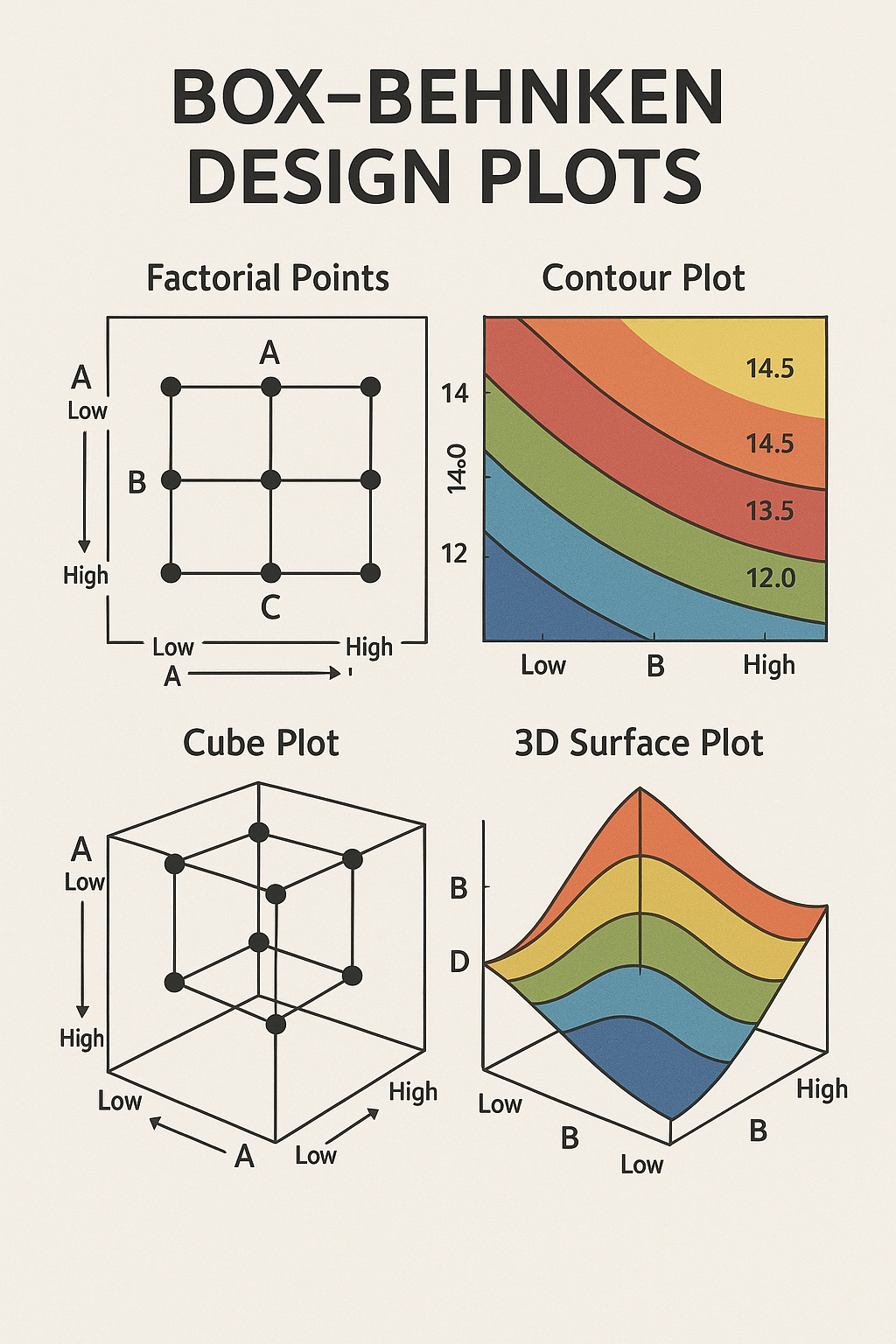
Box-Behnken Designs are an important tool in experimental design, particularly when developing a reliable quadratic model without testing extreme conditions. They provide a structured yet efficient way to explore the effects of multiple factors on a response variable.
By systematically arranging experiments at the midpoints of factor ranges, Box-Behnken designs minimise the number of required tests while capturing valuable information about main effects, interactions, and curvature. They are widely used in engineering, chemistry, and energy research where optimisation is critical.
Box-Behnken Designs are a class of response surface methodology (RSM) designs, introduced by George E. P. Box and Donald Behnken in 1960. They are widely used for modelling and optimising processes where the relationship between input variables and a response needs to be understood — especially when a quadratic model is expected.

Key Features
- Three levels per factor (low, medium, high), but not all combinations are run.
- No corner points: Unlike full factorial or central composite designs, BBD avoids combinations where all factors are simultaneously at their extreme levels. This can protect against testing in regions where responses might be unstable or dangerous.
- Efficient: Requires fewer runs than a central composite design (CCD) for the same number of factors.
- Rotatability: Box-Behnken designs are nearly rotatable, meaning the variance of predictions is nearly the same at points equidistant from the design centre.
Structure
- For three factors, the design points form a cube’s edges, with centre points replicated to estimate pure error.
- For each pair of factors, the design matrix places one factor at its middle level and varies the other two between low and high.
For example, with three factors (A, B, C), the design would include runs like:
- (Low, Low, Centre)
- (High, Low, Centre)
- (Low, High, Centre)
- (High, High, Centre)
- (Centre, Low, Low)
- (Centre, High, Low)
- etc.
The full design ensures that:
- Each factor is tested at all its levels.
- Main effects, two-factor interactions, and quadratic terms can be estimated.
- The design is balanced and efficient.
Advantages
- Safety: No extreme (corner) combinations — useful when these are costly or risky.
- Efficiency: Fewer experimental runs compared to CCD, especially as factor numbers increase.
- Good prediction ability for quadratic response surfaces.
Limitations
- Not suitable if you need to explore very high or very low regions thoroughly (since no corner points).
- Requires three or more factors to be constructed meaningfully.
Famous Case Study: Optimising PEM Fuel Cells
One notable application of Box-Behnken designs is in optimising the performance of Proton Exchange Membrane (PEM) fuel cells.

Researchers aimed to optimise key operating parameters:
- Operating pressure (e.g., 1 atm to 3 atm),
- Operating temperature (e.g., 50°C to 90°C),
- Reactant humidification level (percentage of relative humidity).
The goal was to maximise the current density and power output while maintaining system durability and efficiency.
Using a Box-Behnken design:
- Three factors were varied systematically at three levels.
- The design required fewer runs than a full factorial or a central composite design.
- No experiments were conducted at the extreme conditions (e.g., maximum pressure and maximum temperature simultaneously), which was beneficial for avoiding membrane dehydration or catastrophic failure.
The resulting data allowed researchers to fit a second-order polynomial model to the current density:

Where 
Findings:
- Temperature had a significant quadratic effect — too high temperatures degraded performance due to membrane dehydration.
- Pressure improved current density up to a point, after which diminishing returns set in.
- Humidity showed a strong interaction with temperature — high humidity improved performance at higher temperatures.
Ultimately, the BBD approach led to an optimised operating window, achieving a 15–20% increase in peak power output compared to traditional baseline settings — all with a 30% reduction in the number of experiments compared to a comparable CCD.
This approach saved significant experimental time and resources while ensuring reliable predictions across the range of interest.
Practical Considerations
- When choosing between Box-Behnken and Central Composite Designs (CCD), consider whether extremes need testing.
- Replicates at the centre point are strongly recommended to provide a good estimate of experimental error.
Further information
For a more detailed overview of response surface designs, including Box-Behnken, see: Response Surface Designs.
For more on the Development services of Product Development Engineers Ltd, see: Development Services.