In structural engineering, the term Execution Class (EXC) refers to a classification system defined in EN 1090-2: Execution of Steel Structures and Aluminium Structures – Part 2: Technical requirements for steel structures. Execution classes establish the degree of quality assurance, inspection, and documentation required during fabrication and erection, ensuring that steel structures are constructed to a standard commensurate with their safety and functional importance.
Execution classes are fundamental to the CE and UKCA marking regimes, providing a harmonised basis for structural steelwork across Europe and the UK.
What Are Execution Classes?
Execution classes are categorised from EXC1 to EXC4, with each class reflecting the criticality of the structure, the potential consequences of failure, and the demands on workmanship. They cover aspects such as welder qualifications, welding procedure approval, dimensional tolerances, non-destructive testing (NDT), material traceability, and the level of documentation required.
It is important to note that the execution class must be specified by the designer. The steelwork contractor is only permitted to deliver projects up to the class for which they hold certification from a Notified (EU) or Approved (UK) Body.
The Four Execution Classes
Execution Class 1 (EXC1)
Applies to simple structures with low consequences of failure and limited design complexity.
- Typical for agricultural and domestic structures such as barns, greenhouses, or small sheds.

- Subject only to static loading, with little risk to human life.
- Minimal documentation and inspection are required.
- Connections are generally simple bolted joints or fillet welds.
Execution Class 2 (EXC2)
The default execution class if none is specified.
- Covers the majority of residential, commercial, and light industrial buildings.

- Designed mainly for static loading without severe fatigue demand.
- Requires welder qualifications, welding procedure qualification records (WPQRs), and routine inspection.
- Material traceability is required for more critical elements.
Execution Class 3 (EXC3)
Intended for safety-critical or fatigue-sensitive structures.
- Includes bridges, stadia, crane runways, offshore platforms, and tall towers.

- Requires stricter welding procedures, higher welder qualifications, and more extensive WPQRs.
- Non-destructive testing is significantly more rigorous.
- Material traceability and dimensional tolerances are tightly controlled.
Execution Class 4 (EXC4)
Reserved for exceptional, high-consequence structures.
- Applies to nuclear facilities, long-span suspension bridges, and unique infrastructure projects.

- Demands the highest possible levels of quality assurance, inspection, and traceability.
- Rarely specified in practice, reserved for extreme safety scenarios.
Determining the Execution Class
The selection of an execution class is based on three factors:
- Consequence Class (CC): Defines the consequences of structural failure (CC1 low, CC2 medium, CC3 high).
- Service Category (SC): Describes the loading environment (SC1 static loading, SC2 fatigue/dynamic loading).
- Production Category (PC): Reflects the complexity of manufacture (PC1 simple, PC2 complex).
The combination of CC, SC, and PC guides the appropriate execution class under EN 1090-2. For example, a CC2/SC1/PC1 building would generally fall into EXC2, while a CC3/SC2/PC2 bridge might require EXC3 or even EXC4.
Why Execution Class Matters
Execution class selection affects all stakeholders in the delivery of a steel structure:
- Designers must specify the appropriate execution class to ensure compliance with EN 1090-2.
- Fabricators must be certified for the relevant class, demonstrating their competence to deliver work at the required level.
- Clients and asset owners benefit from confidence that the steelwork has been executed to a standard appropriate to the structure’s risk profile.
Execution classes provide a direct link between structural reliability, fabrication quality, and safety assurance, ensuring that steelwork is delivered with the level of control appropriate to its purpose.
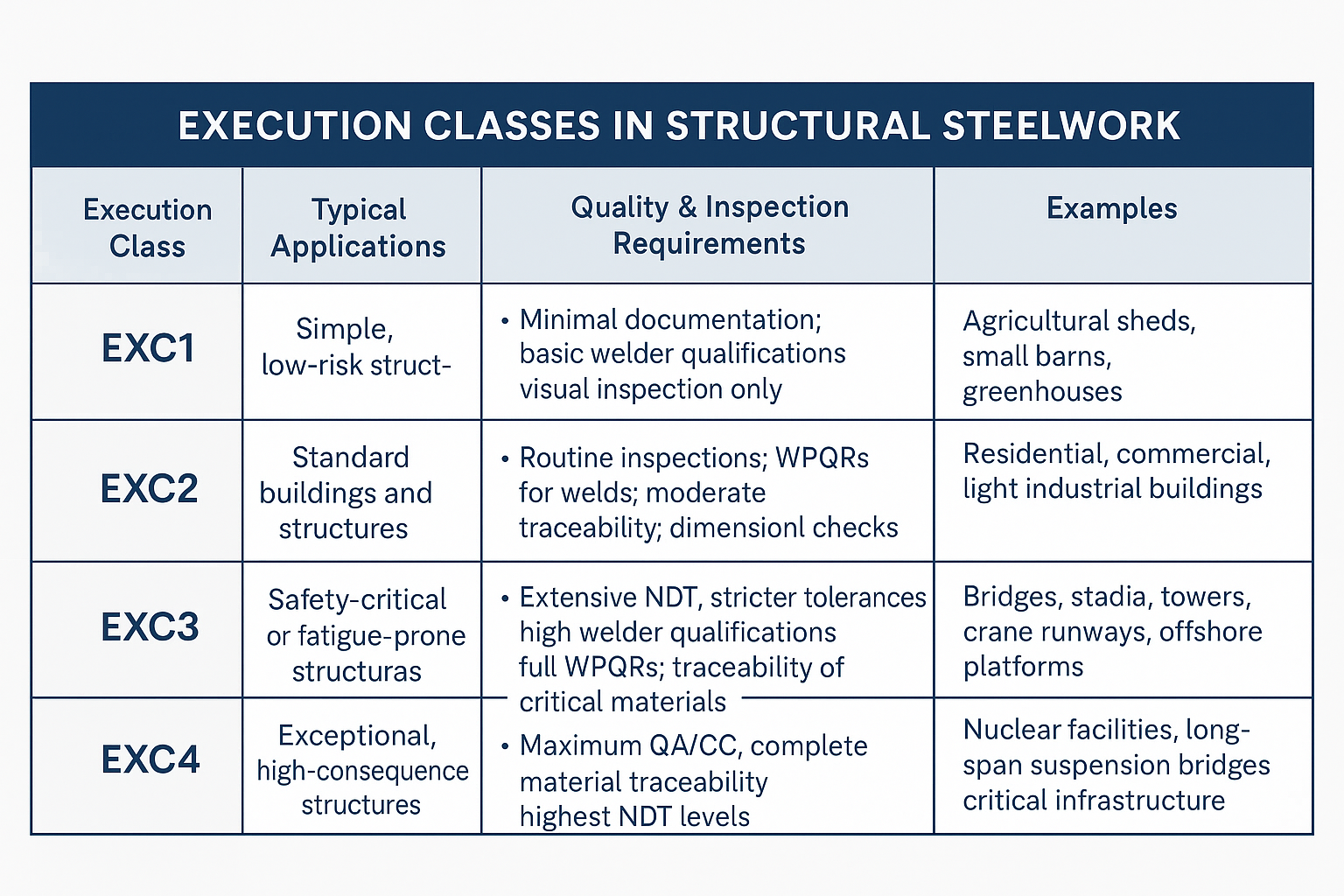
Visual Summary of Execution Classes
| Execution Class | Typical Applications | Quality & Inspection Requirements | Examples |
|---|---|---|---|
| EXC1 | Simple, low-risk structures | Minimal documentation; basic welder qualifications; visual inspection only | Agricultural sheds, small barns, greenhouses |
| EXC2 | Standard buildings and structures (default) | Routine inspections; WPQRs for welds; moderate traceability; dimensional checks | Residential, commercial, light industrial buildings |
| EXC3 | Safety-critical or fatigue-prone structures | Extensive NDT; stricter tolerances; high welder qualifications; full WPQRs; traceability of critical materials | Bridges, stadia, towers, crane runways, offshore platforms |
| EXC4 | Exceptional, high-consequence structures | Maximum QA/QC; complete material traceability; highest NDT levels | Nuclear facilities, long-span suspension bridges, critical infrastructure |
Responsibilities of Designers and Fabricators
Execution classes involve obligations for both designers and fabricators, but the nature of those obligations differs.
Designers
Designers are responsible for specifying the correct execution class within drawings, specifications, or structural notes. This determination must be made in accordance with EN 1990 (Basis of Structural Design) and EN 1090-2 Annex B, which link consequence class, service category, and production category to the appropriate execution class.
Unlike fabricators, designers are not subject to EN 1090 certification or audit. Their accountability stems from professional duties (for example under the Institution of Structural Engineers or ICE codes of conduct), as well as statutory frameworks such as the UK Building Regulations and the Construction (Design and Management) Regulations. Failing to specify the correct execution class could expose a designer to professional or legal liability, but there is no formal EN 1090 assessment regime for designers.
Fabricators
Fabricators, on the other hand, must be formally certified under EN 1090-1 (CE or UKCA marking). This certification, granted by a Notified Body (EU) or Approved Body (UK), confirms that the fabricator’s Factory Production Control (FPC) system is capable of meeting the requirements of the highest execution class for which they are approved.
Regular surveillance audits ensure compliance, covering aspects such as welding coordination, material traceability, non-destructive testing, and documentation. A fabricator may only supply work up to the level of their certification — for example, a workshop certified for EXC2 cannot deliver EXC3 projects.
For a more in-depth review of key points for fabricators, see: Fabrication Requirements.
Summary
Execution classes (EXC1–EXC4) under EN 1090-2 establish the level of quality assurance required in steelwork execution. They ensure that the degree of control, testing, and traceability matches the consequences of failure. Designers must specify them, and fabricators must be appropriately certified. This system underpins both the safety and compliance of modern steel structures across Europe and the UK.
Structural design is one of the services offered by PDE Ltd. For more detail on our full design service portfolio, see: Design Services.