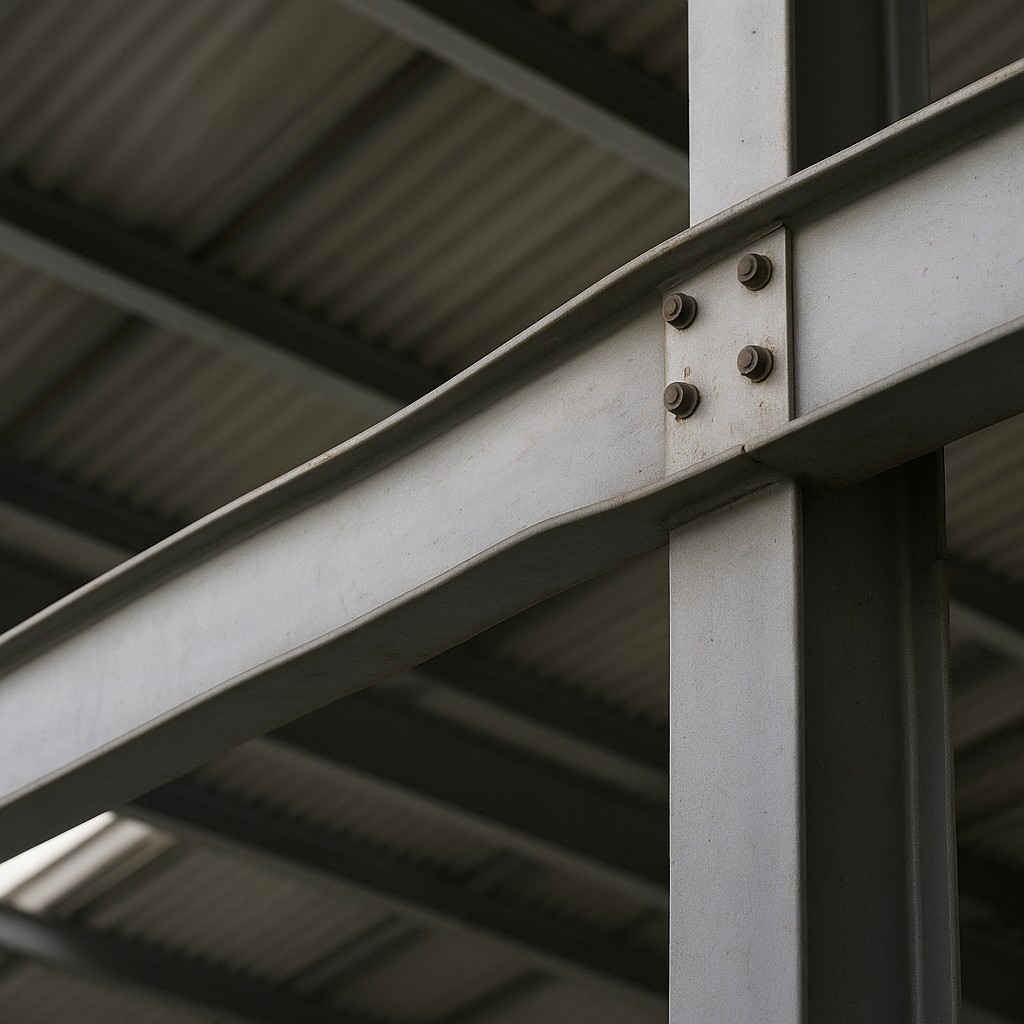
Lateral torsional buckling (LTB) is a stability phenomenon that affects slender beams subjected to bending. It occurs when a beam, instead of simply bending about its major axis, experiences simultaneous lateral displacement and twist, leading to a sudden out-of-plane failure. Understanding and preventing LTB is critical in the design of steel and aluminium structures where cross-sectional slenderness and lateral unbraced lengths are significant factors.
This mode of failure is addressed explicitly in EN 1993-1-1 (Eurocode 3), where reduction factors and critical moment equations are applied to ensure the safe load-carrying capacity of flexural members.
Conceptual Background
Under pure bending about the major axis, the top flange of a beam is in compression while the bottom flange is in tension. For beams with insufficient lateral support, the compression flange tends to deflect laterally and twist, particularly if the torsional stiffness or warping resistance is low.

The result is a coupled lateral and torsional instability that typically governs design for long, slender members.
Governing Equation and Critical Moment
The critical moment for lateral torsional buckling, for a simply supported beam with uniform bending moment, is given by:

Where:


The above equation incorporates both torsional and warping resistance and is exact for the boundary condition of simple supports with ends free to warp.
Non-Uniform Bending
In practical cases, bending moments vary along the beam. For non-uniform moment distributions, a moment gradient factor 

where 
Values for
Buckling Curve and Slenderness
LTB resistance is evaluated using a non-dimensional slenderness parameter 

Where:


The reduction factor 

![\phi = 0.5 [1 + \alpha (\lambda_{LT} - 0.2) + \lambda_{LT}^2]](https://s0.wp.com/latex.php?latex=%5Cphi+%3D+0.5+%5B1+%2B+%5Calpha+%28%5Clambda_%7BLT%7D+-+0.2%29+%2B+%5Clambda_%7BLT%7D%5E2%5D+&bg=ffffff&fg=000&s=1&c=20201002)
Where 
The design buckling resistance is:

Where 
Worked Example
A simply supported steel I-beam has:
- Length
- Yield strength
- Section modulus
- Minor axis inertia
- Torsional constant
- Warping constant


Compute 
Assuming 

Conclusion
Lateral torsional buckling is a critical limit state in beam design, especially for unbraced spans or open thin-walled sections. The use of critical moment expressions, non-dimensional slenderness, and reduction factors from EN 1993-1-1 provides a conservative and standardised approach for ensuring structural integrity. Accurate section property calculation, unbraced length control, and boundary condition awareness are key to effective mitigation.